Explore the ideas

What can we repair,
and who gets to decide?

Behind the book’s mythology is a practical question: how do we live with one another when harm is unavoidable and repair is still possible?

Try the Two-Minute Keystone Compass

Three ideas to carry with you.

From The Infinite Garden Cycle

The Will-to-Repair

Beneath our urge to survive is an urge to mend. It can appear in an apology, an act of care, a piece of art, or the decision to rest.

Repair can begin with something as small as choosing not to make things worse.

What is one small thing you could help to mend?

The Sufferer’s Power

“You don’t owe the world a lesson from your pain.”

The one who carries the wound gets to decide how it's healed. Leaning into it, or reducing it, or fully releasing it are all valid paths; nobody else can declare the wound closed.

Can you offer care without taking control?

The Do No Harm Keystone

An ethical floor for the choices we make:

  1. Don’t directly harm a conscious being except to immediately defend yourself or someone else.
  2. Keep indirect harm as low as you can.
  3. Repair the harms you cause.

Notice harm. Reduce it. Repair it.

The Two-Minute Keystone Compass

A small pause before
the next choice.

Think of a decision in front of you. These questions offer a place to begin. Some decisions need more time.

  1. Notice

    Who could this hurt? Whose perspective is missing?

  2. Reduce

    What is the lowest-harm option I can take now? If I’m unsure, which is easier to undo?

  3. Repair

    If harm happens, can I ask what the person needs? Am I pressuring them to forgive or find meaning?

An honesty check

Would I still choose this option if everyone saw my motive and its likely consequences?

Adapted from The Two-Minute Keystone Compass in The Infinite Garden Cycle.

The wider possibility

What if we’re all part of a larger consciousness?

The book explores that possibility through Filter Cosmopsychism with Temporary Amnesia. You can question its mythology and still explore its ethics of care and repair.

Read the consciousness framework

Before The Infinite Garden Cycle dives into mythology and ethics, it rests on a theory of consciousness: that one wider consciousness is locally expressed through embodied filtering, memory limits, and self-modelling.

In less academic language:

We can call this framework Filter Cosmopsychism with Temporary Amnesia, and it’s the philosophical bridge between the IGC’s Vast Soul and its practical ethic of everyday repair. This theory asks: What if consciousness is less like a spark produced separately by each brain, and more like one ancient light filtered through each of our nervous systems?

If so, then our nervous systems don’t just passively receive a universal signal. They shape it and send something back: a private life, a particular body, a local history, a wound no one else can carry, a form of joy no one else can repeat.

The Temporary Amnesia that keeps each life from remembering another’s is the boundary that makes this privacy possible. It lets each life feel fully its own, while the wider consciousness learns through all of them, one perspective at a time.

This is the philosophical scaffold beneath The Infinite Garden Cycle’s ethic of repair. If each of us is an expression of one wider consciousness, then harm and healing happen inside a single extended conscious system. Cruelty becomes more than damage done to someone else. It becomes damage within the larger fabric that makes our minds possible.

Believing this theory isn’t required to read the IGC. It’s an optional lens. One the book keeps asking in each chapter: if we might be each other, what do we owe each other?
Find the framework on Closer To Truth

In Landscape of Consciousness, see “Hopkins’ Filter Cosmopsychism with Temporary Amnesia”.

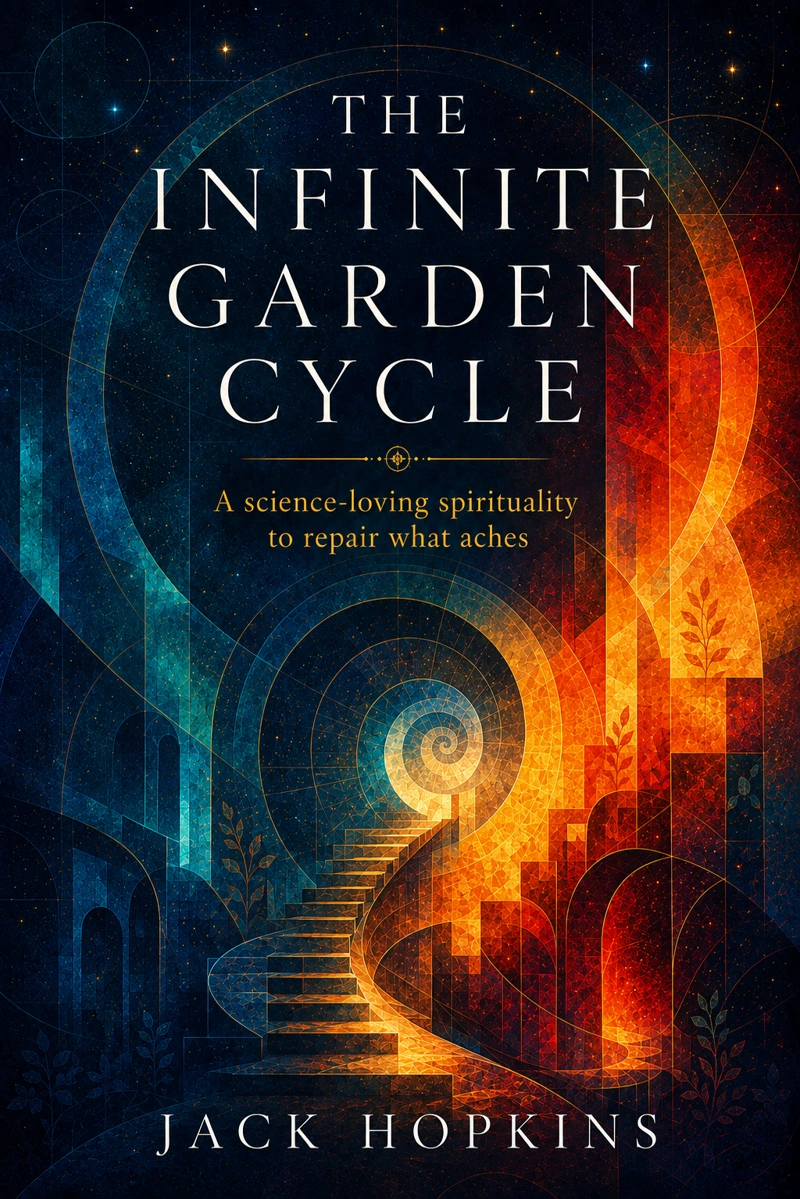
The Infinite Garden Cycle by Jack Hopkins
From ideas into story

Step inside the book.

Read The Unanswered Agony, a vignette from Science: The First Canvas.

Follow the book to publication

Join Jack’s mailing list for excerpts and publication news.

Join the mailing list

Get excerpts and publication news from Jack.